
Monday, July 18, 2011
The Tao of Penalty Kicks--PKs Just Are . . . So Deal With It
Thanks to the Twitterverse, public bellyaching about the injustice of using penalty kicks to decide a tournament began only minutes after the United States Women's National Team lost the Women's World Cup to Japan. By the end of today, I expect all the usual tropes to be trotted out, such as "It's like using a home run derby to decide a baseball game!" or "Having a free-throw contest determine the NCAA Finals!" Actually, it's not like these things at all. The most appropriate analogy to major American sports is the use of penalty shots as a tie-breaker for hockey games, which, of course, the NHL now does throughout the regular season. Granted, during the NHL playoffs, this tie-breaker is scrapped because a series format is used, unlike the one-off, knock-out tournament approach used in World Cups. Now, we can debate the merits of overtime or a three-match series approach versus penalty kicks ad infinitum, but, the truth is, that would be a colossal waste of time. Penalty kicks are not going anywhere. As any footy fan vaguely familiar with the opaque and corrupt machinations of soccer's governing body, FIFA, could tell you, reform is not something that concerns the bureaucratic Illuminati of international soccer. So, we can bemoan the justness of penalty kicks, but that would be about as productive as grousing about the shape of the letter "F." Penalty kicks just are. They are not fair. But, ultimately, they are what you make them--an unforgettably dramatic way to win (see Brandi Chastain in 1999) or a cruel, gut-wrenching way to lose.

Saturday, July 16, 2011
Derek Jeter in a Post-DJ3K World--What's Next?
Last weekend, Derek Jeter reached and eclipsed the 3,000 hit plateau with inimitable, Jeterian flair. But now that the warm glow of the DJ3K honeymoon has receded, the Yankees, as a franchise, could be excused for asking the Captain "What's next?" After all, they owe him $40 million more over the next two-and-a-half seasons. During the first week of Jeter's DL stint, Mark Feinsand of the Daily News, who appears on the "Daily News Fifth" segment of the Yankees' WCBS radio broadcast, noted that if you erase the names and look at the stats, batting Brett Gardner leadoff is a no-brainer. That's not particularly insightful, mind you, but that kind of clear-headed, independent thought qualifies as revolutionary during a broadcast that features Yankee mouthpieces Suzyn Waldman and John Sterling. Basically, if you bump The Captain off of leadoff, the only logical place to put him is at or near the bottom of the order. And you can't do that to The Captain. The horse (in the form of A-Rod's criminally insane contract) is already out of the barn, but the strained tone of Jeter's last contract negotiation suggests the Yankees have realized that the lionization of certain individuals isn't necessarily good for business, especially when you have one of the strongest brands in international sports history. What Jeter does next--in terms of accepting a move off of SS or a move down the order--will challenge the Yankees' powers of image management. In English soccer, there's a cliche that "No player is bigger than the club." The Yankees may be belatedly coming around to that school of thought.
Note Well is Changing--The Anti-Grantland Approach
I wanted to quickly touch on a stylistic change I'm making to the site. Going forward, I intend to keep the length of all my posts to around 250 words. I realize that this appears to be a shameless nod to the Twitterification of all things, and I admit cannot categorically deny that charge. However, the primary reason for this change is much more banal--I have a day job. By keeping my posts succinct, I hope to post more frequently and explore a wider range of topics. Plus, it's probably best to leave the long-form journalism and phone-hacking to the professionals. Hopefully, readers will be able to find time to check out some posts that will be short but not often sweet. Ok, I have to go; I don't want to exceed my word limit.
Friday, June 24, 2011
Boondoggle--Boone Logan May Be the Key to the Yankees' Bullpen . . . and Season
Despite achieving considerable success at the helm of the Florida Marlins and New York Yankees, Joe Girardi doesn't always look the part of a respected baseball manager. His appearance lacks a Piniellaesque gravitas. Maybe it's his diminutive stature, somewhat baggy uniform or mouth full of braces. On Tuesday night, though, when Joe marched out of the dugout to make a pitching change in the ninth inning of the Yankees' win over the Cincinnati Reds, I wouldn't have crossed his path if you paid me. It wasn't so much that Girardi looked angry, he looked downright murderous. Not that I blamed him, mind you. Watching Boone Logan pitch can do that to a man.
Logan, who had just come on in relief of the similarly unreliable Luis Ayala, inherited a runner on first and was tasked with retiring reigning NL MVP Joey Votto. If successful, he probably would have been allowed to mop up the final outs to give Mariano Rivera the night off. Alas, it wasn't to be. Logan promptly plunked Votto with his first pitch and out stormed Girardi in a hot funk.
Logan, who had just come on in relief of the similarly unreliable Luis Ayala, inherited a runner on first and was tasked with retiring reigning NL MVP Joey Votto. If successful, he probably would have been allowed to mop up the final outs to give Mariano Rivera the night off. Alas, it wasn't to be. Logan promptly plunked Votto with his first pitch and out stormed Girardi in a hot funk.
 |
| A Yankee fan, upon realizing that Boone Logan may have to face David Ortiz in the ALCS. |
BOONE OR BUST?
Here's the problem with Boone Logan--he's a LOOGY (Lefty One Out GuY) who's not very good at getting left-handed batters out. Over the course of six MLB seasons, lefties have a .252 batting average against him, and while that's not terrible, it's not really the kind of dominance contending teams are looking for out of a left-handed specialist. And this year, as Logan has relied on a low-90s fastball and slider, lefties are hitting him at a .286 clip. It's a small sample size, of course, but it's unimpressive and indicative of his mediocrity. Ultimately, it's his career numbers, compiled over more than 800 batters faced, that put to rest the argument that the Yankees have to wait until Logan "comes around." At this point in his career, what you see is what you get--a guy with WHIP nearing 1.6 who doesn't miss enough bats (his K/BB ratio is only 1.77).
Now, here's the other problem with Boone Logan--he's the only LOOGY the Yankees have, and he's out of options, meaning he cannot be sent down to the minors until he clears waivers. Given the sad state of the LOOGY population throughout the league, if the Yankees let him go, he'll get snapped up by another, still more desperate team. It wasn't supposed to be like this. Logan was supposed to be a guy who kept his warm up jacket on and watched from the 'pen as Pedro Feliciano, fresh off a dominant 2010 campaign with the Mets, handled high-
Now, here's the other problem with Boone Logan--he's the only LOOGY the Yankees have, and he's out of options, meaning he cannot be sent down to the minors until he clears waivers. Given the sad state of the LOOGY population throughout the league, if the Yankees let him go, he'll get snapped up by another, still more desperate team. It wasn't supposed to be like this. Logan was supposed to be a guy who kept his warm up jacket on and watched from the 'pen as Pedro Feliciano, fresh off a dominant 2010 campaign with the Mets, handled high-
Sunday, June 19, 2011
Let's Face It, Rioters Are Fans, Too
In the wake of the instantly infamous riots that gripped Vancouver after the Canucks' loss to the Boston Bruins in the NHL's Stanley Cup finals last week, I heard a couple of media personalities try to rationalize the debacle by claiming that the perpetrators weren't "real" hockey fans or Canucks supporters. This tired excuse, which is faithfully trotted out in the U.S. whenever fan hijinks devolve into mob violence, begs an obvious question. Here, one has to ask who, exactly, were those troublemakers kitted out in bespoke Canucks' paraphernalia? Were they a particularly organized flash mob of anarchists? Probably not. In fact, a lot of them probably were passionate Canucks fans. They were too passionate, clearly, and quite stupid, as well, but fans, nonetheless. It's probably time for us, as a sporting culture, to put on our big boy pants and realize that.
A HISTORY OF VIOLENCE
Obviously, this isn't our first brush with fan violence. In an analogous incident from May 2008, hooligan supporters from Glasgow soccer club Rangers expressed their displeasure with their club's humbling loss to Zenit St. Petersburg in the UEFA Cup Final by cutting a swath of destruction through the host city of Manchester that was described as being as bad as anything the area had suffered "since the Blitz." Sadly, tales of soccer hooliganism are legion, with Italy's Serie A providing many of the recent battlegrounds, but fan delinquency isn't cabined to European soccer. How about those lovably loyal Cleveland Browns fans who gave us a bottle tossing incident in 1991 that Nick Bakay dubbed "The Day It Rained Pilsner?" Or the night in 2004 when fans attempted a coup at the Palace at Auburn Hills during a NBA regular season game between the Detroit Pistons and Indiana Pacers? More recently, Major League Baseball was rocked by the savage beating of a San Francisco Giants fan outside of Dodgers Stadium in Los Angeles. For crissakes, this isn't even the first post-Game 7 Stanley Cup Finals riot in the city of Vancouver. The fact that lists like this are nowhere near exhaustive only speaks to my point.
And, yet, America's sports media continues its self-serving refusal to acknowledge that the whole premise of the bad-fans-aren't-real-fans argument is laughably flawed. I suppose it's bad business to tell your audience that they sometimes act like common criminals, but it's an insult to a viewer's intelligence to act like "real" sports fans are morally incapable of behaving badly.
FANCIER OR FANATIC?
There's some etymological uncertainty over whether the word "fan" was, when first applied to baseball fans during the 19th century, a shortened form of the word "fancier" or "fanatic." Usually, the majority of sports fans in this country (and probably the rest of the world) act more like fanciers than fanatics; however, when fanaticism takes primacy in sports, things can get ugly, just as they do when fanaticism dominates political or religious spheres.
Ultimately, people are capable of acts of malice and profound stupidity. "Real" sports fans are people. So, they, too, are capable of the kind of deviance that roiled Vancouver last week. Let's face it, good fans are capable of being bad people.
A HISTORY OF VIOLENCE
Obviously, this isn't our first brush with fan violence. In an analogous incident from May 2008, hooligan supporters from Glasgow soccer club Rangers expressed their displeasure with their club's humbling loss to Zenit St. Petersburg in the UEFA Cup Final by cutting a swath of destruction through the host city of Manchester that was described as being as bad as anything the area had suffered "since the Blitz." Sadly, tales of soccer hooliganism are legion, with Italy's Serie A providing many of the recent battlegrounds, but fan delinquency isn't cabined to European soccer. How about those lovably loyal Cleveland Browns fans who gave us a bottle tossing incident in 1991 that Nick Bakay dubbed "The Day It Rained Pilsner?" Or the night in 2004 when fans attempted a coup at the Palace at Auburn Hills during a NBA regular season game between the Detroit Pistons and Indiana Pacers? More recently, Major League Baseball was rocked by the savage beating of a San Francisco Giants fan outside of Dodgers Stadium in Los Angeles. For crissakes, this isn't even the first post-Game 7 Stanley Cup Finals riot in the city of Vancouver. The fact that lists like this are nowhere near exhaustive only speaks to my point.
And, yet, America's sports media continues its self-serving refusal to acknowledge that the whole premise of the bad-fans-aren't-real-fans argument is laughably flawed. I suppose it's bad business to tell your audience that they sometimes act like common criminals, but it's an insult to a viewer's intelligence to act like "real" sports fans are morally incapable of behaving badly.
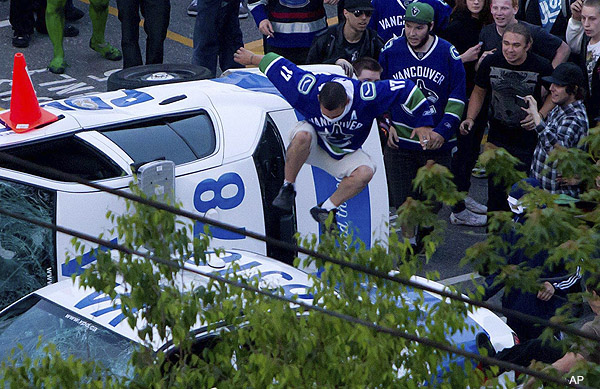 |
| Are these people you'd invite to your housewarming party? No, but that doesn't mean they aren't sports fans. |
FANCIER OR FANATIC?
There's some etymological uncertainty over whether the word "fan" was, when first applied to baseball fans during the 19th century, a shortened form of the word "fancier" or "fanatic." Usually, the majority of sports fans in this country (and probably the rest of the world) act more like fanciers than fanatics; however, when fanaticism takes primacy in sports, things can get ugly, just as they do when fanaticism dominates political or religious spheres.
Ultimately, people are capable of acts of malice and profound stupidity. "Real" sports fans are people. So, they, too, are capable of the kind of deviance that roiled Vancouver last week. Let's face it, good fans are capable of being bad people.
Saturday, June 11, 2011
Denial in Yankeeland--The Red Sox Can (and Probably Will) Ruin Our Summah
As a lifelong fan of the New York Yankees, I have a some fond memories of the legendary 1998 team that won 125 games en route to World Series sweep of the sacrificial San Diego Padres. In particular, though, I vividly remember watching a May game against the Boston Red Sox at Fenway Park. It was the second time the teams had met that season, and the day earlier, a Sox lineup of pseudo "stars" (Mo Vaugh) and bona fide scrubs (Darren Lewis, Troy O'Leary, Jon Valentin, Darren Bragg, Mike Benjamin and Lou Merloni) had, behind Tim Wakefield, somehow won the opening game of the series. The next day, normal service was restored, and as the Yankees were putting the sword to the Sox on their way to a 12-3 rout, one of their announces (Ken Singleton, maybe?) said, "This is just one team telling another, 'Hey we're better than you.'" While watching the Sox administer the second Bronx beat down of this season earlier this week, those words floated back to me in a kind of Proustian memory. Except this time, it was the Sox who were emphatically delivering that message.
You would think that even those Yanks fans who see the world though rose-tinted, pinstriped glasses issued by YES Network, the Bomber's in-house propaganda arm, couldn't deny that the Sox are a superior team. In fact, the question of whether the Sox are currently better than the Yankees is no longer a subjective one. Unfortunately, it is a fact that the answer is "Yes." These last few games served as a kind of mathematical proof. To argue to the contrary is to deny objective reality and betray a mind warped by homerism. It would be like asserting that John Sterling and Suzyn Waldman are a good radio broadcast team or that Tom Brady's haircut is actually cool. These kind of delusional statements are like dog whistles signaling your listeners that you don't know what the hell you are talking about.

And yet, if you choose to crawl down the rabbit hole of sports talk radio, you'll hear people like WFAN host Mike Francesa argue that the Yankees are as good as or better than the Sox. The current standings, this line of argument theorizes, are skewed by Boston's dominance of this year's head-to-head match-up. But doesn't that head-to-head dominance actually verify their superiority? Whatever. This kind of denial is made more irrational by the reality that it doesn't matter who is the best team in early June. Of course, Yankee fans shouldn't be too optimistic about the Yankees overhauling the Red Sox anytime soon, especially now that the bullpen is in shambles and Bartolo Colon just injured one of his ponderous legs. That the health of Colon matters this much is, in and of itself, troubling, but without beefy Bartolo and his magic arm, we're left with the tragicomic prospect of watching A.J. Burnett pitch Game 2 of a post-season series. The Yanks will likely look to make a move before the deadline, but, then again, won't the Sox, as well? As much as I'd like to deny it, the truth is it could be a while before the Yankees can once again tell the Red Sox, "Hey, we're better than you."
Sunday, April 17, 2011
Diabolical--The Extreme Makeover of Arizona State's Uniforms Says a Lot About What's Wrong With College Sports
I have to admit that I've always had a soft spot for "Sparky," the pitchfork-wielding imp, who until last season, was emblazoned on the Arizona State University Sun Devil's football helmets. It wasn't because he was particularly demonic. On the contrary, Sparky looked pretty harmless; despite his weapon, he appeared to be wearing a red Hoodie Footie Snuggle Suit and bore a passing resemblance to Jon Lovitz's Mephistopheles from Saturday Night Live. But what he lacked in ferocity, he made up for in biography. Legend has it that, in the late 1940s, Bert Anthony, an ASU alum and former Disney employee, modeled Sparky's mischievous face after his former boss, Walt Disney. I'm not totally sold on that tale, but regardless of its veracity, it's still a great story. The possibility that a school's mascot may actually be a satanic caricature of one of America's most beloved entertainers is part of the romance that makes college sports special.
Apparently, Arizona State's not much for romance. Last week, the school effectively put a pitchfork in Sparky, opting for an Arena League-esque football uniform (and complete range) designed by repeat uniform desecrator Nike. Sparky has not been consigned to the underworld--he'll remain the mascot and will appear on one side of the back of the football helmet--but it's a pretty big demotion. And for what? ASU traded 65 years of homegrown history and a good urban legend for a trendy redesign (complete with obligatory, all-black alternate strip) authored by a company started by a famous alum (Phil Knight) of a conference rival (Oregon University). Talk about selling your soul to the devil.
In deference to tradition, most schools celebrate the uniqueness of their outdated or obscure nicknames and uniforms. That's why we still have Elis, Hoyas, Cornhuskers and Boilermakers. Thankfully, that's why we don't have any schools nicknamed the Mighty Ducks or Raptors. That same reverence of the past is also the reason why we have ancient uniform designs like those of Alabama, Michigan and Princeton. Lately, though, thanks to the remarkable turnaround enjoyed by Oregon University's football program, which roughly coincided with its adoption of gaudy, DayGlo unis, schools like Washington State and now ASU seem more willing to forsake history in an attempt to "shake things up" or inject a "new attitude" into a flailing program. Schools are obviously free to remake their image, but dodgy uniforms and esoteric nicknames are part of the charm of college athletics.
The more that kind of tradition is eroded, the further college sports creep towards professionalism, where, except for a handful of franchises (e.g., the New York Yankees and the Boston Red Sox) it's really just the product on the field that counts with most fans. The problem with that is, as the Tostitos BCS National Championship Game and the NCAA Men's Basketball Tournament Final suggested, the quality of college athletics, even at the highest level, isn't all that good. Different colored fields, ridiculously designed basketball courts and gimmicky uniforms are all masking an ever-widening gap in quality between the professional and collegiate athletics. When all that's left to college athletics is the product on the field, there won't be much of a reason to watch. Each time college athletics loses a Sparky, it takes one step closer to its own kind of purgatory.
Subscribe to:
Posts (Atom)